
By Damian Marciniak, June 28, 2026 · 9 min read
Does your store exist for AI? How to dominate chatGPT and Google AIO recommendations?
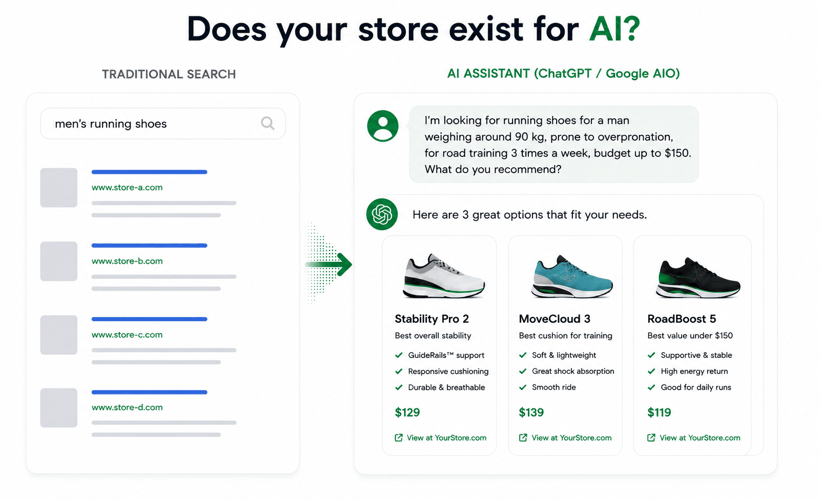
Picture a shopper who, instead of typing "men's running shoes" into a search bar, asks an AI assistant: "I'm looking for running shoes for a man weighing around 90 kg, prone to overpronation, for road training 3 times a week, budget up to $150. What do you recommend?" In the blink of an eye, the artificial intelligence doesn't throw back a standard list of blue links pointing to the homepages of popular storefronts or online marketplaces.
Instead, it generates a complete, tailored response: it highlights three specific models, explains the reasoning behind its choices, compares their cushioning, and provides direct links to stores where these products are available right now.
The ultimate question is: will your store be among those recommendations?
We are entering an era where traditional SEO, built solely on mindlessly stuffing keywords and acquiring mass backlinks, no longer guarantees success. New heavyweights: AI assistants like chatGPT by OpenAI and search features like Google AI Overviews (AIO), are fundamentally rewriting the rules of the e-commerce game. To survive and dominate this new landscape, you must master the principles of GEO (Generative Engine Optimization), the process of optimizing content specifically for generative models like ChatGPT, Perplexity, and Google AI Overviews. This article will guide you through how AI algorithms "think," the ranking factors that dictate product visibility, and how to write in a benefit-driven language that machines understand and gladly pass along to your potential customers.
The era of Generative Engine Optimization (GEO), why traditional SEO is no longer enough
Traditional search engines used to act like librarians. You handed them a phrase, and they pointed to a shelf, handed you a stack of books, and essentially said, "Go find it yourself." AI-powered tools function completely differently; they act as your personal shopping assistants. They comb through hundreds of pages in a fraction of a second, read reviews, evaluate technical specifications, and deliver a polished, cohesive summary of information.
For online store owners, this marks a massive paradigm shift. If your store ranked third in traditional organic search results, you could still count on a steady stream of traffic. In a world ruled by Google and AI assistants, if the algorithm doesn't select you as one of the 3 or 4 core sources powering its answer, you simply cease to exist for that consumer.
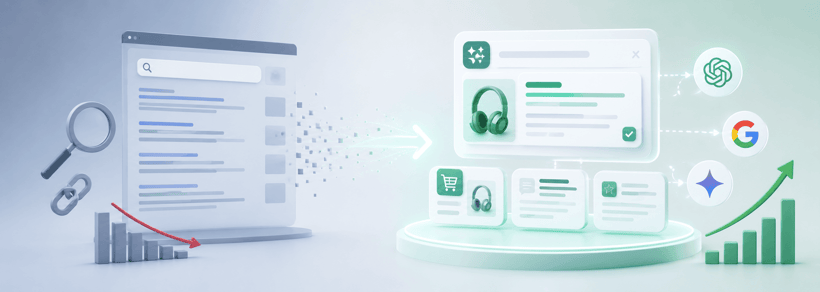
GEO is the strategic framework that ensures language models view your store as the most reliable, precise, and highly recommended source of truth for a given product.
From links to knowledge synthesis. How chatGPT and Google AIO work?
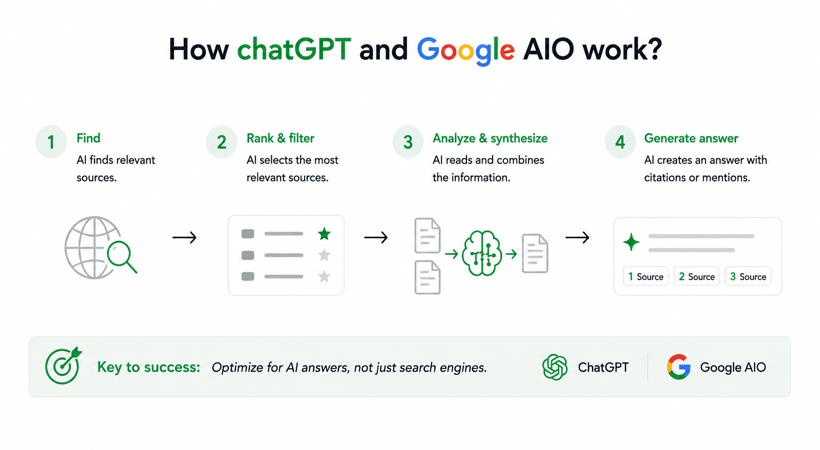
To outsmart the algorithms, you must first understand how they process information. Generative engines aren't looking for a basic 1:1 keyword match for phrases like "cheap lawn mower." Instead, they utilize a mechanism called RAG (Retrieval-Augmented Generation) a technique that feeds fresh knowledge to AI models through enhanced queries.
When a user asks a question, the system:
- Scours the web (or specialized databases) for credible sources tied to the topic.
- Ranks and filters these sources to pinpoint the ones that best match the exact meaning and intent of the question.
- Analyzes and synthesizes the data from the top-ranked sources.
- Drafts an entirely unique textual response rooted in the facts found on those web pages, attaching direct links (known as citations) or mentioning the brands without linking to them (known as mentions).
Google AI Overviews leverages Google’s vast Knowledge Graph alongside native Google Merchant Center integration. Meanwhile, chatGPT pulls its data through direct web crawling in partnership with major publishers, as well as real-time analysis of e-commerce site structures. The ultimate key to success is no longer optimizing for search engine bots, but rather optimizing to deliver ready-made answers for LLMs (Large Language Models).
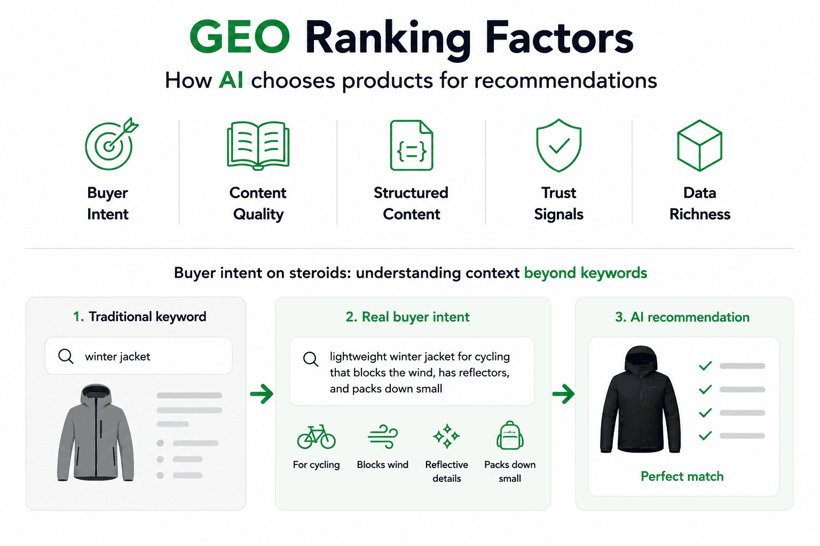
GEO ranking factors. How AI chooses products for recommendations?
While traditional SEO focuses heavily on keyword density and backlink profiles, GEO shifts the spotlight to entirely different ranking factors. Artificial intelligence evaluates your content based on its utility, thoroughness, and how easily it can be parsed by NLP (Natural Language Processing) algorithms.
Buyer intent on steroids: understanding context beyond keywords
Large language models excel at handling long-tail keywords and highly conversational queries. Modern shoppers aren't just looking for an object anymore; they are searching for a solution to a specific problem.
Example: instead of optimizing a product page purely for the phrase "winter jacket," you must fulfill the intent behind: "lightweight winter jacket for cycling that blocks the wind, has reflectors, and packs down into a small backpack."
If your store's descriptions consist entirely of dry technical specs, the AI might fail to connect the dots and realize your jacket is ideal for cycling. You need to anticipate real-world usage scenarios and map them out explicitly across your product pages.
The language of facts and benefits that LLMs understand
Artificial intelligence is highly allergic to "marketing fluff". Vague phrases like "our product boasts premium quality and a unique design that will delight everyone" hold zero value for an LLM. AI routinely filters out subjective adjectives because they contain no hard data. So, how should you write? Pivot entirely toward benefit-driven copy anchored in facts and figures.
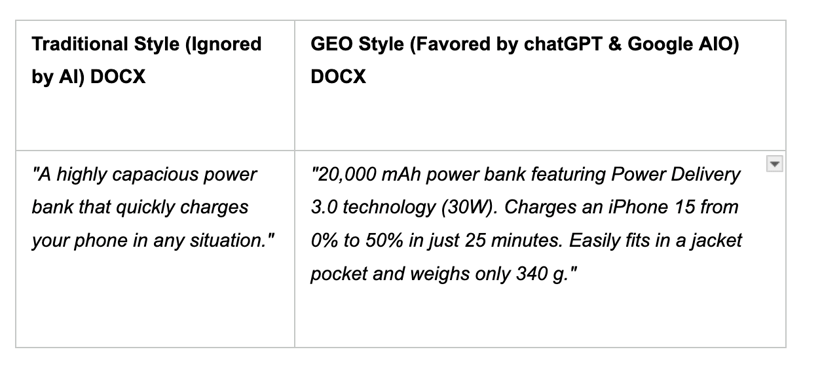
Notice the difference? The second option hands the AI concrete parameters to compare against your competitors. If a user asks for a "power bank under 400g with fast charging for an iPhone," the AI will confidently recommend the product described with exact specs.

Your product’s passport to the AI world. Structured data and merchant center
If your on-page content is the heart of GEO, technical data is its circulatory system. Artificial intelligence must be absolutely certain that the information it serves to a user is perfectly accurate and live. Nothing damages an AI assistant's reliability faster than recommending a product that has been out of stock for months or costs twice as much as the model claims.
Schema.org - the digital translator for Google AI Overviews
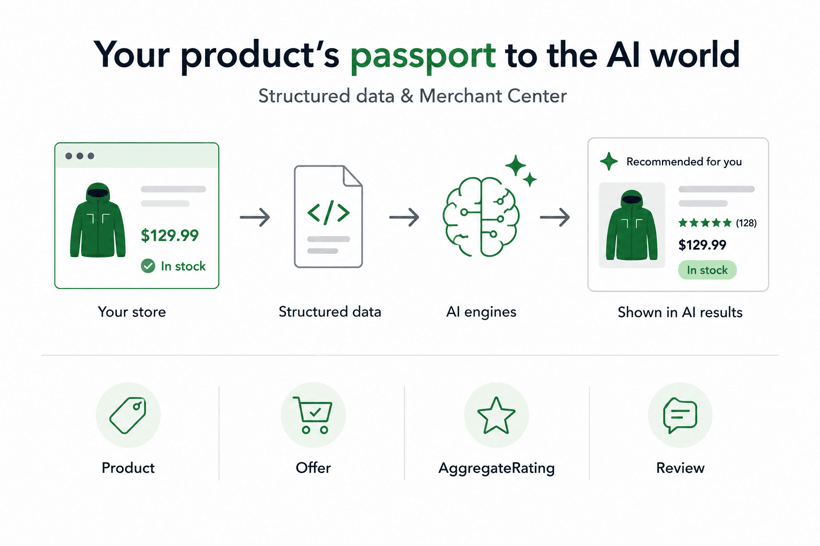
Structured Data is a specialized backend code embedded in your website that explicitly tells search bots: "This is the price, this is the currency, here is the customer rating, and these are the shipping costs." For AI search, implementing comprehensive Schema markup is an absolute necessity.
Ensure that your product pages feature fully deployed, error-free structured data schemas:
- Product (name, brand, description, images)
- Offer (price, availability, currency, return policy)
- AggregateRating (average star rating and total review count)
- Review (individual user reviews, AI loves pulling direct quotes from customer feedback!)
By doing this, the generation engine can pull exact prices and stock levels instantly, displaying your product in recommendation widgets complete with a clean "In Stock" badge.
Why is a precise product feed your strongest asset in chatGPT?
chatGPT and alternative next-gen search engines lean heavily on both open and closed product databases. Within Google's ecosystem, the cornerstone is Google Merchant Center. If your product feed is stripped down, lacking unique EAN/GTIN codes, specific colors, materials, or distinct categories, the AI will simply look past your store and favor a competitor who provided the full data set.
GEO Pro-Tip: make sure attributes like brand, material, size, gender, and color are thoroughly populated in your product feed and perfectly mirror what is displayed on your store's live pages.
Creating AI-citation-friendly content. Designing product pages and blogs
When synthesis engines build summaries, they actively link back to blogs and buying guides that display deep expertise. To transform your content marketing into premium fuel for AI engines, you need to adjust how your texts are structured.
Building authority (E-E-A-T) in the age of the generative revolution
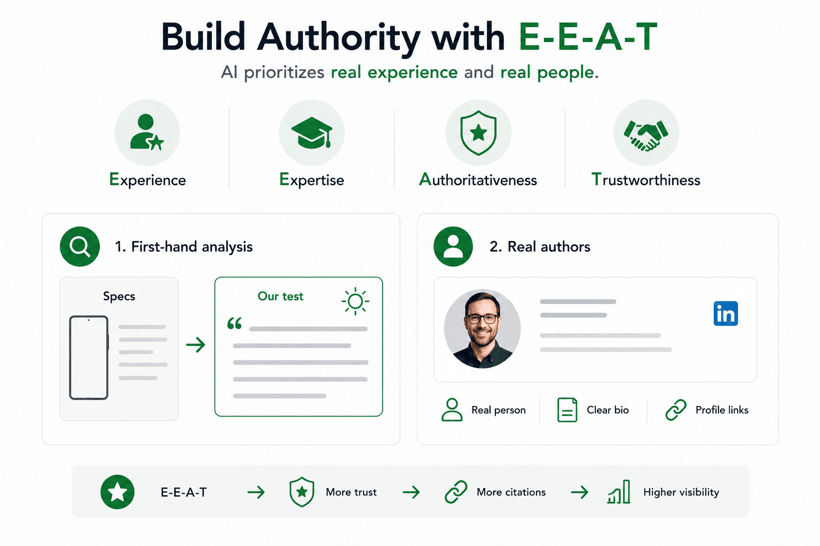
Google has made it clear that amid a web flooded with low-value, mass-produced AI content, the golden ticket to high visibility lies in E-E-A-T (Experience, Expertise, Authoritativeness, Trustworthiness). AI models prioritize firsthand experience.
- Provide First-Hand Analysis: instead of merely rewriting a smartphone's spec sheet, write: "We tested this model under direct sunlight, and the display remains perfectly legible; however, during 4K video recording, the chassis warms up noticeably after 15 minutes."
- Highlight Real Authors: AI favors citing sources anchored to verifiable humans-authors identified by first and last name, complete with professional bios and links to career profiles like LinkedIn.
Q&A structures and direct answers to complex questions
Language models are inherently fond of Question & Answering formats. When designing FAQ blocks on your product pages or writing blog entries, use H2 or H3 subheadings formulated exactly like natural human queries.
Example Best Practice: H3 Can a cast iron skillet be washed in the dishwasher? No, you should absolutely never wash a cast iron skillet in a dishwasher. Harsh detergents and intense humidity strip away the natural non-stick seasoning (the patina) and cause rust to form rapidly. The best method is to rinse it with warm water and gently wipe it down with a soft sponge.
This layout presents a perfect, ready-to-use citable fragment that chatGPT or Google AIO can pull directly into their answers, instantly giving your store the coveted attribution link.
The future of e-commerce belongs to AI visibility – your action plan for today
The generative shift isn't a distant trend; it is unfolding right now. Consumers are rapidly stepping away from open-ended browsing across dozens of tabs, choosing instead the quick, precise answers served up by AI assistants. Brands that fail to adjust to GEO risk dropping off the radar of modern consumers entirely.
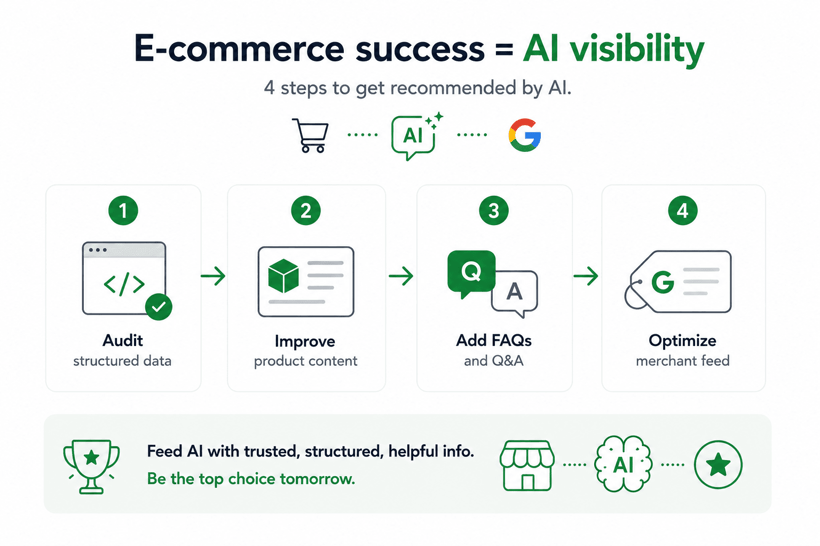
To position your e-commerce store as a top-recommended source in chatGPT and Google AI Overviews, execute these four fundamental steps:
- Step 1: run a comprehensive audit of your structured data. Verify that Schema.org accurately and flawlessly maps out every single product across your site.
- Step 2: rework your product descriptions. Strip out generic marketing fluff and substitute it with hard facts, performance specifications, and real-world utility scenarios.
- Step 3: expand your FAQs and adopt a clear Q&A format on your corporate blog. Deliver clear, direct answers to complex, conversational consumer questions.
- Step 4: clean up and enrich your feed within Google Merchant Center-ensure unique identifiers (GTIN/EAN) and optional attributes are thoroughly filled out.
In the era of AI, success belongs to those who feed the algorithms the most trustworthy, structured, and genuinely helpful information for the end user. Lay that foundation today, and make your store the primary choice for tomorrow's AI engines.
Would you like to innovate your ecommerce project with Hatimeria?

Damian is a seasoned SEO professional with extensive experience across domestic and international markets. He honed his skills leading SEO strategies for top brands, managing complex site audits, technical optimizations, link-building initiatives, and tailored e-commerce growth strategies. He specializes in designing high-impact online visibility strategies, leveraging automation and AI to optimize business processes and solve complex technical challenges. Connect with Damian Marciniak on LinkedIn
Elephate
Elephate is a full-service SEO agency focused on data-driven strategies, automation, and measurable growth. They help e-commerce brands increase visibility, drive qualified traffic, and turn SEO into a sustainable growth channel.