
By Dawid L., October 27, 2026 · 4 min read
Greater Control Over Your Shopify Catalog with an XML Feed
When native synchronization is no longer enough, a dedicated feed allows you to better manage data, test changes, and expand how your products are presented on Google.
When does basic synchronization become insufficient?
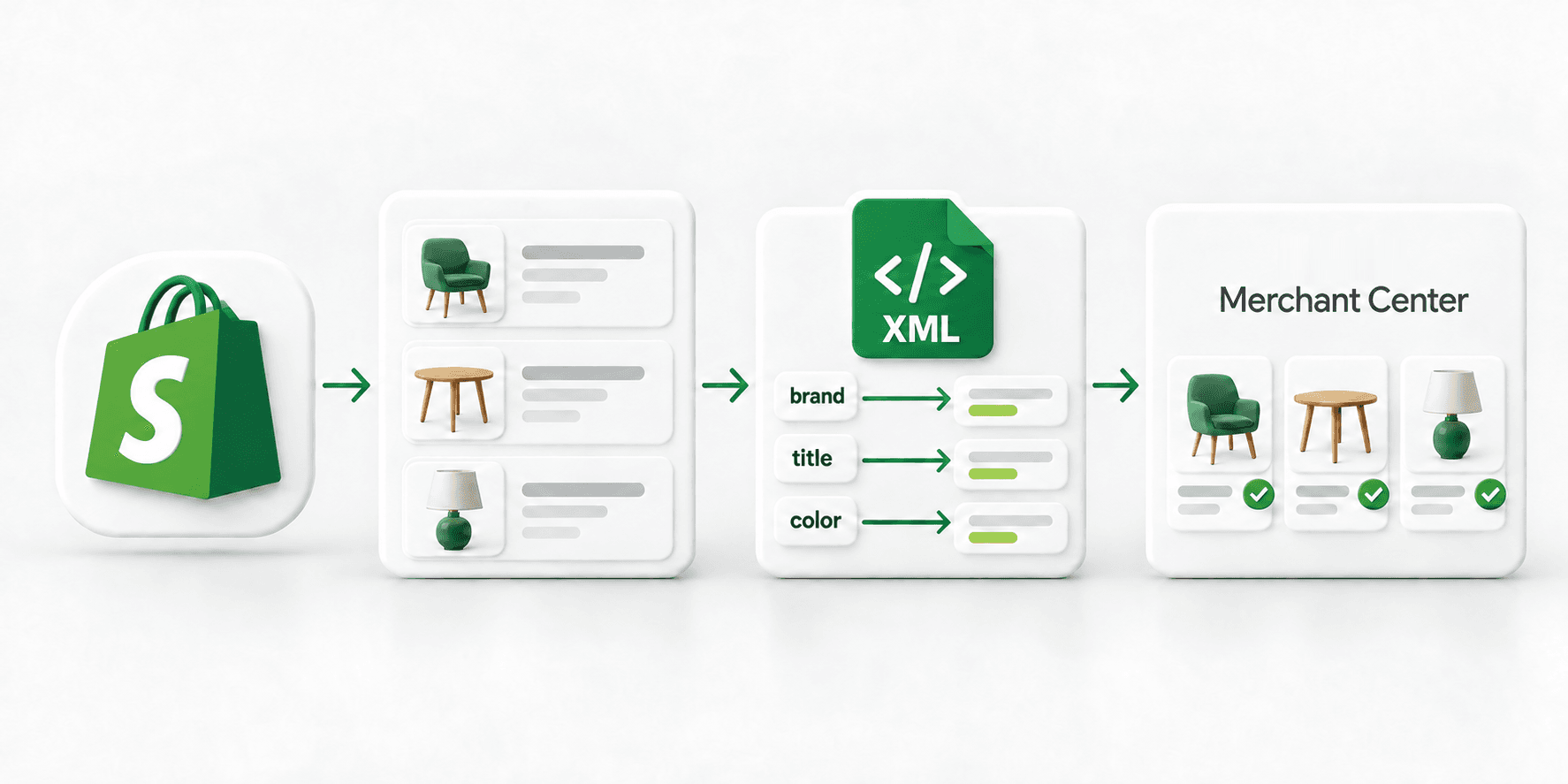
The native Google & YouTube app lets you connect your Shopify catalog to Google Merchant Center and show your products on Google. For many stores, this is a sufficient solution. However, needs change as your catalog grows. Products with multiple variants emerge, additional information is stored in metafields, and requirements for presenting your offer across different channels become more complex. At that point, it’s no longer just about sending data—it becomes essential to have control over which products go to Google, what information they contain, and how to verify changes before publication. In one of our projects, the answer was migrating from native product synchronization to an XML feed generated using the Multi Feeds app.
1. Data Tailored to Google Shopping
We select which Shopify data gets mapped to specific XML fields. We can combine, transform, add, or skip optional attributes.
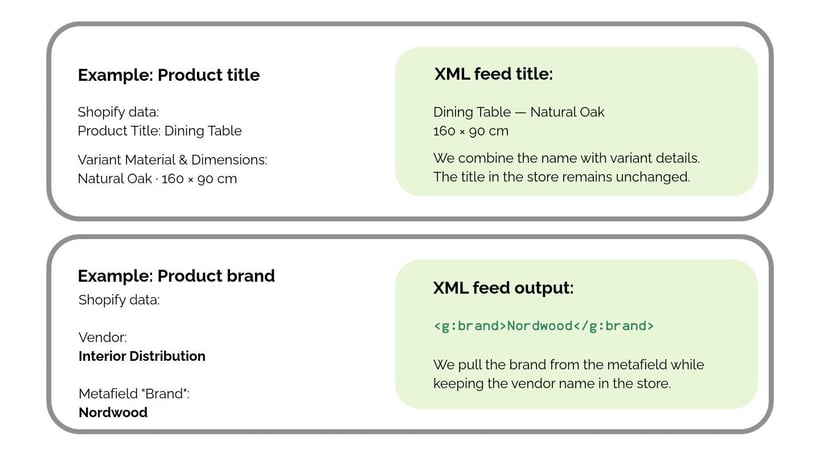
We pull the brand from the metafield while keeping the vendor name in the store. We aren't altering the organization of the catalog—we are tailoring the export. While Google & YouTube offers fixed sync settings, a dedicated feed provides greater control over data sources and processing rules.
2. Utilizing Data You Already Have in Shopify
A store often holds more product information than its basic Google integration utilizes. This can include technical specs, collection tags, or additional product and variant attributes. Metafield mapping and custom formulas allow you to leverage this information in your exports. Instead of maintaining extra data manually in multiple places, your team can manage it right inside Shopify and apply uniform rules across the entire catalog.
3. Control Over Published Offer Scope
Not every product in Shopify needs to be included in every feed. With an extensive catalog, the ability to create separate product sets and define qualification rules becomes invaluable. You can use collections, metafields, and export conditions for selection. This allows you to prepare a feed for a specific product group or start a rollout with a small test collection. Business Benefit: Changes can be implemented in stages rather than applying to the whole catalog all at once.
4. Pre-Submission Verification to Google
An XML feed provides your team with a tangible file to review. Before publishing, you can analyze item IDs, titles, product URLs, prices, availability, and variant relationships. You can also compare successive exports to see which values changed after updating rules. This makes troubleshooting much easier: alongside the final status in GMC, you have the exact input data submitted to Google. File accuracy is just the first phase. After publishing, we also verify processing results and Merchant Center diagnostics.
5. Updates Aligned with Store Operations
Data freshness is crucial in a product feed. Export schedules can be aligned with price updates, data imports, or other operational store processes. Keep in mind that there are two stages: generating the file, and its retrieval and processing by Google. With rapidly changing prices and stock levels, setting the right update frequency is especially critical. The goal is a predictable process where you know exactly when a change in Shopify will be reflected in GMC.
6. Migration Respecting Existing Listings
Changing integrations requires more than just adding a new data source. Preserving existing product identifiers, verifying variant mapping, and keeping track of total offer counts are critical. Google relies on IDs to recognize offers and track their performance history. Unplanned ID changes can disrupt historical data, which is why ID consistency was a key checkpoint during our verification.
How We Conducted the Client's Catalog Migration Analyzed product data in Shopify and the existing GMC catalog. Gathered client requirements and identified migration risks. Prepared the configuration and attribute mapping for the new feed. Tested selected products and variants, ensuring ID consistency. Migrated the entire catalog to the new data source. Verified final offer counts and data accuracy in Merchant Center. Our priority was expanding feed management capabilities while ensuring full continuity for the existing catalog.
What the Client Gained from the Migration The result was greater control over product data sent to Google and the ability to scale the configuration as the store's needs evolve.
- Flexible Rules: Ability to customize data and map attributes according to catalog requirements.
- Catalog Control: Precise selection of products included in specific feeds.
- Easier Verification: An export file that can be checked and compared before going live.
- Scalability: A solid foundation for future testing and product data optimization.
Would you like to innovate your ecommerce project with Hatimeria?

Junior Fullstack Developer, comfortable both with writing code and playing guitar. Studying Computer Science at Cracow University of Technology for the past three years, with a strong focus on teamwork. Passionate about music - from soft tunes to heavy rock - and often spotted at live concerts. Loves fantasy worlds in books and games, especially The Witcher, Cyberpunk, and Metro. Favorite mood booster? Linkin Park, "Numb".